Agentic Coding in 2026: How to Turn an AI Prototype into a Production-Ready Product
A practical CTO guide to the architecture, testing and operating decisions that make an AI-built prototype ready for its first customers.
Challenge
An AI-built prototype can pass a demo while failing under concurrent use, access boundaries or unreliable integrations.
Approach
Define one customer outcome, make business rules explicit, test important failure cases and prepare recovery before a limited release.
Outcome Focus
A first release with a clear audience, verified core workflow and operating boundaries the team can support.
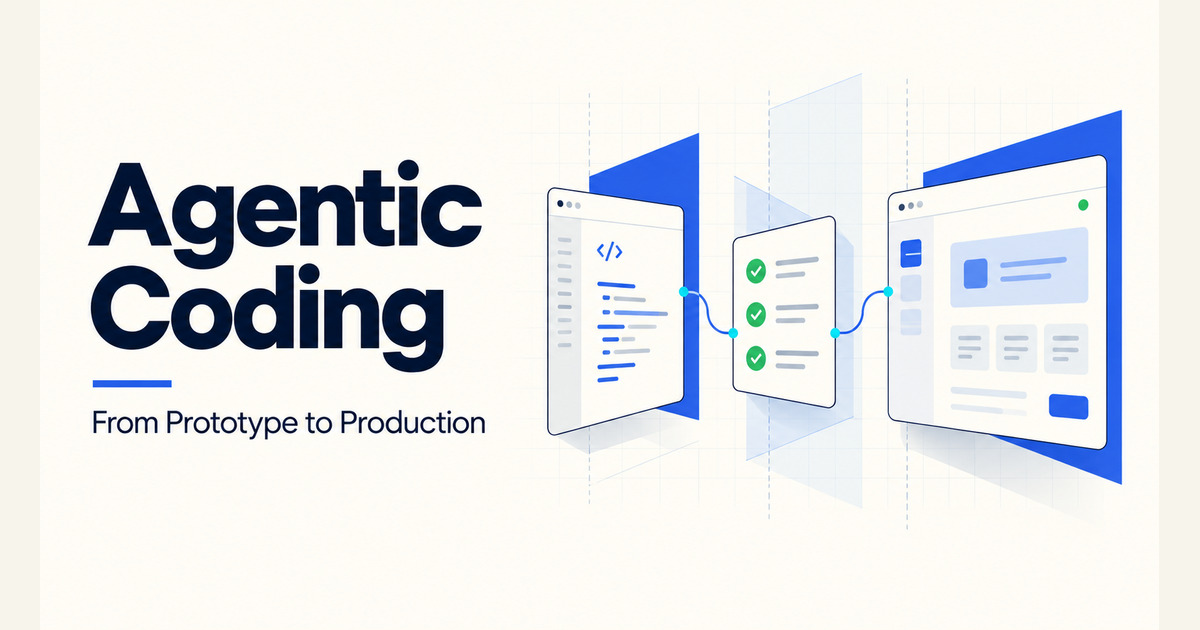
Your AI-built prototype works. Would you put your first paying customer on it?
Agentic coding gives small teams more ways to build, test, and improve software. Turning that capability into a dependable product takes clear requirements, deliberate architecture, and evidence that the system behaves as intended.
The dashboard loads. The sign-up flow works. A booking appears in the database. You can finally show someone the product you imagined.
Then the questions change.
What happens when two customers reserve the last available slot? Can one business see another business’s records? If a payment succeeds but the confirmation arrives late, what does the customer see?
These questions are where a prototype starts becoming a business.
My view as a CTO is optimistic: use coding agents to take on more implementation work. Use the time saved to understand users, check important assumptions, and prepare the product for real operating conditions.
What is agentic coding?
Agentic coding is a software development approach in which an AI system uses tools to work toward a programming goal across multiple steps. Depending on its capabilities and permissions, it can inspect a repository, plan changes, edit files, run checks, and revise its work using the results.
For example, GitHub documents that its Copilot cloud agent can research repositories, implement changes on a branch, and execute tests and linters in a development environment. That makes the interaction broader than asking an assistant to suggest a code snippet. GitHub’s agent documentation
The feedback loop matters. An agent can observe a failing test and attempt a correction. Anthropic’s engineering guidance similarly describes agents using tools and environmental feedback, while emphasising clear success criteria and appropriate oversight. Building effective agents
For founders, the useful question is how to give that loop the right target. An agent needs a definition of success that reflects the business, including the situations a demo may never encounter.
What does production-ready actually mean?
Production-ready software is ready for a defined group of users, a defined workload, and an agreed level of operational risk.
A private pilot for one business has different requirements from a public platform handling thousands of customer accounts. Both need a working core workflow, appropriate access controls, reliable records, and a way to recover from failures.
Use these questions to make readiness concrete:
| Area | Question to answer before launch |
|---|---|
| Customer workflow | Can users complete the promised task without someone editing the database for them? |
| Access control | Does the server enforce who can view and change each record? |
| Data integrity | What prevents duplicate, conflicting, or incomplete business records? |
| Integrations | How does the product handle delayed responses, failed requests, and repeated events? |
| Operations | Who notices a failure, and how will they investigate and recover? |
| Cost | What does serving an active customer cost under realistic usage? |
These questions should shape the release scope. If a feature introduces a risk the team cannot yet manage, simplify it or defer it.
An illustrative example: the booking screen that works
Imagine a small hostel booking application. This is an illustrative scenario, not a completed Solvrz client case study.
A coding agent helps build a room list, availability calendar, booking form, and payment status page. Everything works when one person tests the flow.
Now two receptionists try to reserve the same bed for overlapping dates at almost the same time. Both screens showed it as available when they opened.
The business rule must be explicit: a bed cannot have overlapping confirmed reservations. The application needs to enforce that rule when it commits a reservation, with database-level protection or an appropriate transaction strategy. A frontend availability check alone cannot settle competing requests.
Payment introduces another question. If a payment provider delivers the same event twice, should the booking receive two payment entries? Stripe documents that webhook events can be duplicated and can arrive out of order. A payment integration must account for those behaviours. Stripe webhook documentation
This is why a more useful task for a coding agent is:
Implement booking confirmation so that concurrent requests cannot confirm overlapping stays for the same bed. Add a test that submits competing requests and verifies that only one succeeds. Repeated processing of the same payment event must not create another payment entry.
The instruction connects implementation to observable business behaviour. That gives both the agent and the reviewer something meaningful to verify.
A practical path from AI prototype to first customer
1. Choose one complete customer outcome
Start with the task that makes the product worth using.
For the booking example, that could be: a receptionist assigns an available bed, records the amount owed, and completes check-in.
Describe the starting conditions, the expected result, and the main exceptions. Decide what should happen if the selected bed becomes unavailable or the guest changes dates.
Keep the first release narrow enough to test thoroughly. A smaller, complete workflow can give you better customer feedback than several partly connected features.
2. Make the important architecture decisions explicit
Before generating more features, document where business rules live, how records relate, and how permissions work.
If the application serves multiple businesses, identify how every relevant request is restricted to the correct business. If it handles payments, decide how external payment events become internal records. If it runs background jobs, decide how failed jobs are retried without repeating a completed action.
For an early product, my default would be the simplest architecture the team can operate confidently. Add infrastructure when a specific requirement justifies it. Every additional service creates another deployment, failure mode, and maintenance responsibility.
3. Give agents useful repository context
A coding task should include enough context to avoid accidental decisions about the product.
Keep a short, maintained project guide covering the architecture, development commands, critical business rules, and verification steps. Explain where new code belongs and identify areas that require particular care.
Assign changes that are small enough to review. Ask for a summary of what changed, which checks ran, and what remains uncertain. GitHub supports repository instructions specifically to provide this kind of project context. Customising agent knowledge
The objective is to make correct work easier to produce and easier to assess.
4. Test the assumptions that would hurt customers
A successful build confirms only part of the picture. Tests can also pass while checking the wrong behaviour.
Review test expectations against the original requirements. For the hostel example, useful checks include simultaneous booking attempts, access from a different business account, repeated payment events, and interrupted check-in requests.
Give the most attention to boundaries involving money, permissions, shared inventory, and irreversible changes. Use realistic examples and failure conditions. If an agent writes both the implementation and its tests, examine whether both share the same mistaken assumption.
A second AI review may help find issues, but agreement between models is not proof of correctness. Look for evidence from execution, explicit business rules, and review of the relevant logic.
5. Prepare to operate the product
Before inviting customers, decide how you will detect and handle a problem.
You should be able to identify failed requests, trace an important action without exposing sensitive information, restore backed-up data, and explain who owns an incident. Check that secrets stay outside source code and that development environments do not have unnecessary production access.
Plan recovery for both application changes and database changes. Redeploying an older version of the application does not automatically reverse a destructive data migration.
For a small pilot, these arrangements can be straightforward. They still need to exist and be tested where a failure would be costly.
6. Release to a limited group and learn
Begin with a clearly defined pilot audience. Tell participants what is supported, how to report problems, and what assistance is available.
Watch whether they complete the core task. Record where staff intervene, which errors recur, and what customers misunderstand. Set limits on usage or spending where unexpected demand could create an unaffordable bill.
Expand when the evidence supports expansion. Let actual use guide the next feature decisions.
Measure the whole delivery process
Generating more code is useful only when it improves delivery and customer outcomes.
To assess agentic coding in your team, track a small set of measures:
| Measure | What it helps you understand |
|---|---|
| Time from an agreed task to a verified release | Whether implementation speed survives review and testing |
| Rework after review or release | Whether faster drafting creates extra correction work |
| Defects affecting customers | Whether reliability improves or deteriorates |
| Customer task completion | Whether the software delivers the promised outcome |
| Operating and support cost per active customer | Whether the product can be served sustainably |
Compare similar work where possible and record changes in scope or team experience. Treat the results as evidence about your workflow, rather than a universal claim about AI productivity.
Also distinguish AI-assisted development from AI-powered functionality. A product built with a coding agent does not necessarily need a model running inside it. If the product itself uses AI, evaluate that behaviour separately for task accuracy, data access, latency, and cost.
Build faster with a clear definition of ready
Agentic coding creates an opportunity to spend less effort on repetitive implementation and more effort on the decisions that make software useful.
The strongest next step for an AI-built prototype is to define what must be true before a customer depends on it. Choose the essential workflow. Make the business rules explicit. Verify the important failure cases. Prepare recovery. Then launch at a scale you can support.
At Solvrz, our product engineering approach connects definition, validation, and release readiness. We help organisations design, build, and launch AI-powered software with attention to how it will operate. Explore Solvrz’s capabilities
Have an AI-built prototype and want a clearer path to launch? Share your product brief, target users, and current technical challenges with Solvrz. We can help you define the architecture, validation steps, and next release.
Contact hello@solvrz.com to start the conversation.
Evidence Snapshot
- Production-readiness questions covering workflows, access, data integrity, integrations, operations and cost.
- An explicitly illustrative booking scenario tests competing reservations and duplicate payment events.
- A six-step release framework and delivery measures grounded in review, execution and customer outcomes.
Connected Reading
Follow the related product path
Keep reading
AI MVP Development Company: How To Choose A Build Partner
A practical guide to choosing an AI MVP development company: the evaluation criteria, questions, and red flags that separate a product build partner from a demo shop.
AI MVP Development Services: What To Build Before You Scale
AI MVP development services should turn an AI idea into a testable product build with workflow design, evaluation, review controls, and launch evidence.