The right AI MVP development company should reduce product risk before it scales spend, not sell a demo that breaks on real data.
Evaluate a build partner on workflow ownership, evaluation discipline, data handling, review controls, and who owns the product after launch.

Solvrz Team
Solvrz
Challenge
Founders and product teams often select an AI MVP development company on portfolio and price, then discover the build cannot survive real users, real data, or a compliance review.
Approach
Assess a build partner against a fixed rubric: scoped problem ownership, model boundary, evaluation criteria, data and review controls, and post-launch ownership.
Outcome Focus
Select a build partner that ships a testable AI product increment with evidence, not a fragile prototype that has to be rebuilt before it can scale.
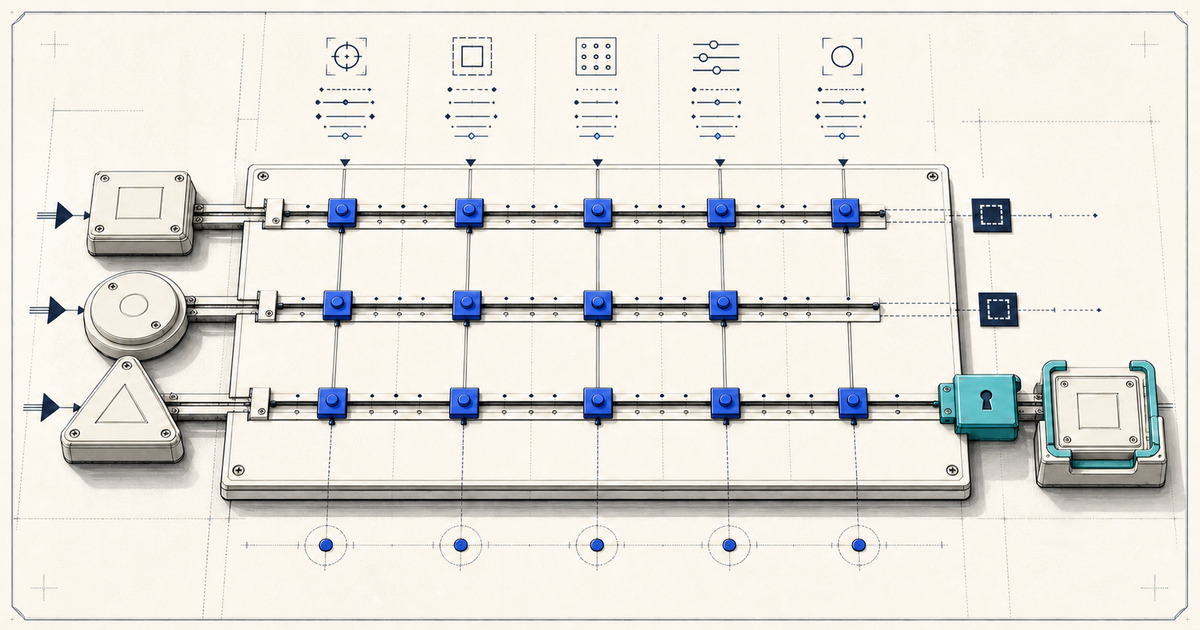
Choosing an AI MVP development company is a product-risk decision, not a procurement one. The wrong partner ships a convincing demo that collapses the moment real users, inconsistent data, and a compliance reviewer arrive. The right partner reduces uncertainty before you commit more spend, data access, or operating risk.
This is a companion to our note on what to build before you scale an AI MVP. That piece covers scoping the build. This one covers the harder question once scope is clear: how do you tell a genuine AI MVP development partner apart from a demo shop?
Challenge: Portfolios And Price Hide The Real Risk
Most selection processes rank vendors on portfolio, headcount, and day rate. None of those predict whether an AI MVP will hold up in production.
An AI build fails in ways a traditional software build does not. The model behaves differently on inputs it has not seen. Data that looked clean in a pitch is missing fields, permissions, or context in reality. A summariser that impressed in a demo starts producing plausible but wrong output, and no one has defined what "wrong" means or who catches it. By the time these show up, the contract is signed and the timeline is committed.
The evaluation problem is that a good demo and a good product look identical for the first ten minutes. The difference only appears under load: edge cases, quality expectations, review, logging, and someone accountable for the output. A selection process that never tests for those signals is selecting on the wrong axis.
Approach: Evaluate Against A Fixed Rubric
Replace "show us your portfolio" with a fixed set of questions applied to every candidate. A serious AI MVP development company answers these concretely; a demo shop answers them with adjectives.
- Scoped problem. Can they restate your goal as one user, one workflow, and one job-to-be-done, rather than "an AI assistant"? Narrow scoping is a capability signal, not a limitation.
- Model boundary. Can they say what the AI should do and what deterministic rules should still own? A partner that wants AI to do everything has not thought about reliability.
- Evaluation criteria. Do they define what good, bad, and risky output looks like, and how it will be measured, inside the statement of work?
- Data handling. Do they ask which records are available, permissioned, and reliable before quoting a build, rather than after?
- Human review. Do they design who approves, edits, rejects, or escalates AI output, and what happens when quality drops?
- Post-launch ownership. Do they specify who maintains prompts, rules, data, analytics, and feedback after handoff?
The pattern to look for is a partner that makes the product question smaller and more measurable. Custom AI MVP development services should reduce your risk with each decision, not defer it to a later phase.
Outcome: A Testable Increment With Evidence
The output of the right engagement is not a finished platform. It is a working product increment plus a decision you can defend: scale, narrow, rebuild the data layer, add review controls, or stop.
A build partner worth selecting should leave you with a clickable workflow or working internal tool, a documented model or retrieval architecture, evaluation criteria with sample test cases, human review and escalation rules, basic analytics for usage and correction rate, and a next-stage roadmap grounded in evidence from the first release. If a proposal cannot describe these deliverables, it is describing a prototype, not an MVP.
Solvrz runs this as a hybrid studio: we deliver client MVPs and apply the same operating discipline to internal IP, so the handoff artefacts we describe — prompt ownership, analytics, and release control — are the same ones we live with internally. See the research side in Solvrz Labs and the delivery side in our AI development services.
Evidence: A Build-Partner Evaluation Checklist
Use this rubric to score every AI MVP development company on the same axis before comparing price.
| Evaluation area | Question a strong partner answers concretely |
|---|---|
| Problem scope | Can they name one user and one workflow the MVP will prove? |
| Model boundary | What does AI own, and what stays deterministic and rule-based? |
| Evaluation | How is output quality defined and measured, and is it in the SOW? |
| Data readiness | Which source data is available, permissioned, and reliable for the first test? |
| Review controls | Who approves, edits, or escalates output when quality drops? |
| Analytics | How will usage, exceptions, and correction rate be tracked after launch? |
| Ownership | Who maintains prompts, rules, data, and feedback once the build ships? |
| Proof | Can they show a product they built and still operate, not only a demo? |
If a vendor cannot answer most of these, the gap is not experience — it is that they are selling a demo. For workflow-heavy scope, pair this with our AI automation sprint approach; for language-intensive products, see generative AI and RAG development.
{
  "@type": "FAQPage",
  "mainEntity": [
    {
      "@type": "Question",
      "name": "How do I choose an AI MVP development company?",
      "acceptedAnswer": {
        "@type": "Answer",
        "text": "Evaluate every candidate against a fixed rubric rather than portfolio and price. A strong AI MVP development company can restate your goal as one user and one workflow, define the model boundary, put evaluation criteria and human review into the statement of work, ask about data readiness before quoting, and specify who owns prompts, analytics, and feedback after launch."
      }
    },
    {
      "@type": "Question",
      "name": "What is the difference between an AI MVP development company and a demo shop?",
      "acceptedAnswer": {
        "@type": "Answer",
        "text": "A demo shop ships a convincing prototype that works on curated inputs. An AI MVP development company ships a testable product increment with defined evaluation criteria, human review paths, analytics, and post-launch ownership, so it can survive real users, real data, and a compliance review."
      }
    },
    {
      "@type": "Question",
      "name": "What should custom AI MVP development services include in the statement of work?",
      "acceptedAnswer": {
        "@type": "Answer",
        "text": "The scope should name the user and workflow, the AI role versus deterministic rules, the evaluation criteria and how quality is measured, the data access pattern, human review and escalation rules, launch analytics, and who maintains the system after handoff."
      }
    }
  ]
}
Evidence Snapshot
- A credible AI MVP proposal names the user, the single workflow, the model role, the failure cases it will not tolerate, and the first metric it will report.
- Evaluation criteria and human review paths should appear in the statement of work, not be deferred until after the first demo.
- A hybrid studio that also builds and operates its own products can show how prompts, data, analytics, and release ownership are maintained after handoff, not just at delivery.
Connected Reading
Follow the related product path
Keep reading
AI MVP Development Services: What To Build Before You Scale
AI MVP development services should turn an AI idea into a testable product build with workflow design, evaluation, review controls, and launch evidence.
Agentic Coding in 2026: How to Turn an AI Prototype into a Production-Ready Product
Learn how to turn an AI-built prototype into a production-ready product with a practical CTO guide to architecture, testing, security, and launch readiness.